Living Profile
A living profile for every person
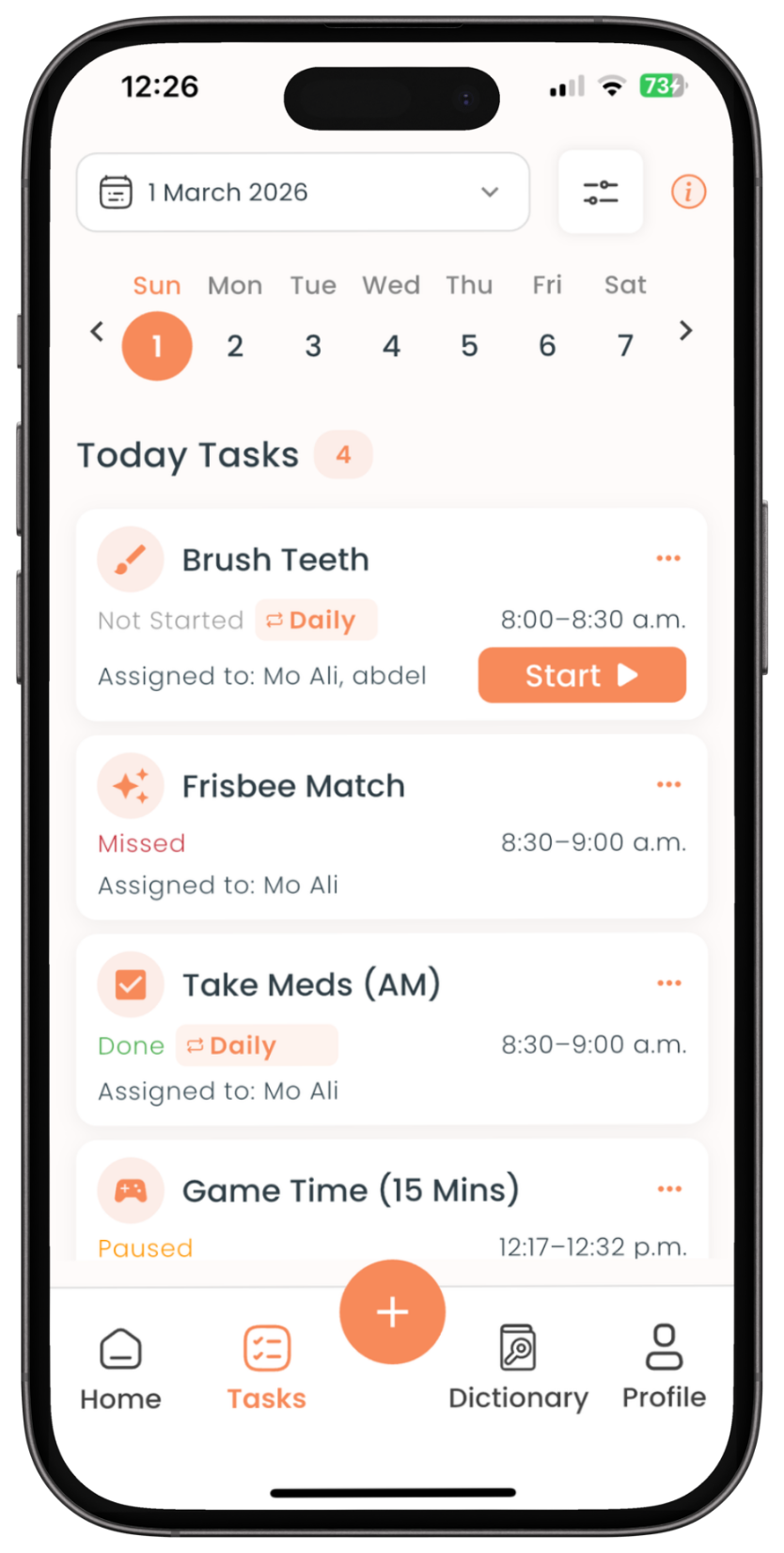
Cues, routines, triggers and how they communicate, kept current in one place the whole care circle can see. So that someone covering their first shift knows the person, not just the schedule.
Align what your whole team knows about a person, so a handover is not a scramble and a cover shift is not a guess. One living profile, one tap logging, and a daily summary that writes itself.
No IT project. No procurement. Staff download an app.
 Design partner, Mississauga
"It saves us more than an hour a day. It took our logging from an hour and a half down to 30 minutes."DEEN Support Services, a GTA charity supporting people with disabilities
The daily win is real, but it is not the whole return. What MORO does in a shift, in a week, and over a year are three different things.
The same Tuesday, run two ways. Nothing about the person changes. Only what the worker has in front of them.
Someone books vacation. Someone calls in sick. Someone new starts on Monday. This is where most organizations are one person deep, and they only find out the hard way.
Intake stops being a stack of paper, and documentation stops being a project you do after the fact.
Upload the existing binder through the dashboard instead of retyping it into a system.
Records build themselves as the team works, so the answer already exists when someone asks for it.
A mobile app for staff and families, plus a web dashboard for the organization.
Cues, routines, triggers and how they communicate, kept current in one place the whole care circle can see. So that someone covering their first shift knows the person, not just the schedule.
Staff tap once when something happens. MORO captures the time and offers quick context chips, plus an optional note. So that logging takes seconds in the moment, not an hour of remembering at the end of a shift.
Everything logged rolls up into a clean end of day summary: tasks done, observations with context, anything missed. So that handoff notes stop being homework.
Checklists ordered by what is late, active or coming up, with a handoff banner so the next shift sees where things stand. So that nothing falls through the cracks between the morning team and the afternoon team.
Progress notes, incident reports and daily summaries in one searchable, tagged timeline instead of paper, texts and group chats. So that "did anyone write that down?" always has the same answer: yes, and here it is.
Intake forms, consents and reports live with the person's profile. Upload existing paperwork straight through the dashboard. So that the binder retires, and day one of a pilot starts with real information already in place.
"Not an EHR, not a billing system, not clinical charting."
Most organizations your size already have something for compliance and claims, and you should keep it. Nothing to migrate, nothing to rip out. Systems of record are built for auditors. They are not built for the ten seconds after something happens.
Compliance, billing, claims, medication administration, scheduling. Unchanged, and still yours.
The shared profile, one tap logging, the handoff, and the family side. The parts that happen during a shift.
Your price depends only on team size, and it is agreed in writing before your pilot starts.
Staff means active users of the organization dashboard, not your payroll. Casual and on-call workers who never log in do not count. Early adopter pricing is for the first 20 organizations and your rate is locked for as long as you stay. Annual billing is two months free.
Rather than asking your whole organization to change anything, start with a single team.
Kickoff, 30 minutes. Staff onboarded, participants loaded, success criteria agreed together.
Check in. What is working, what is in the way.
Results measured against the goals you set on day zero.
You decide. If it did not save time, you walk away.
Your price and tier are agreed in writing before the pilot starts, so there is no surprise at the end. The decision date goes on the calendar from day one. Sign within a week of the pilot ending and your first three months are 20% off.
That is the real risk, and it is why logging is one tap rather than a form. At DEEN, 7 of 10 participants had activity recorded inside the first two weeks, and 9 features shipped during the pilot because staff told us what was in the way. If your team will not use it during the four weeks, you will know before you have paid anything.
Keep it. MORO is not an EHR, a billing system or a clinical charting tool, so there is nothing to migrate and nothing to replace. It is the layer your staff touch during a shift, which is the part most systems of record were never designed for.
A 30 minute kickoff. No servers, no procurement, no hardware. Staff download an app and you self serve from the web dashboard after we register your organization. You can upload existing intake paperwork through the dashboard so profiles start with real information in them.
MORO is a communication layer rather than a clinical or EHR system, which changes the shape of that conversation. The specifics of what we store, where, and for how long are questions Mo should answer directly rather than a website paragraph, so we put them on the agenda for your call.
It stays with the family. The profile belongs to them, their history is kept, and it travels with them to any new program. The family app is free forever, and that does not change based on whether your organization is a customer.
Then the tiers above probably do not describe you well. We build one flat rate around how you actually work. Tell us what your team looks like.
In Use Today At Four Care Organizations across the GTA
Accelerators & Awards two first place, non dilutive


If it does not save your team time, you walk away. No cost, no strings, price agreed in writing before day one.
info@moroapp.ca · Toronto, Canada · Families always free on iOS and Android